The Guinea-a-Year Library That Kept Victorian Novels in Three Volumes
5 min read
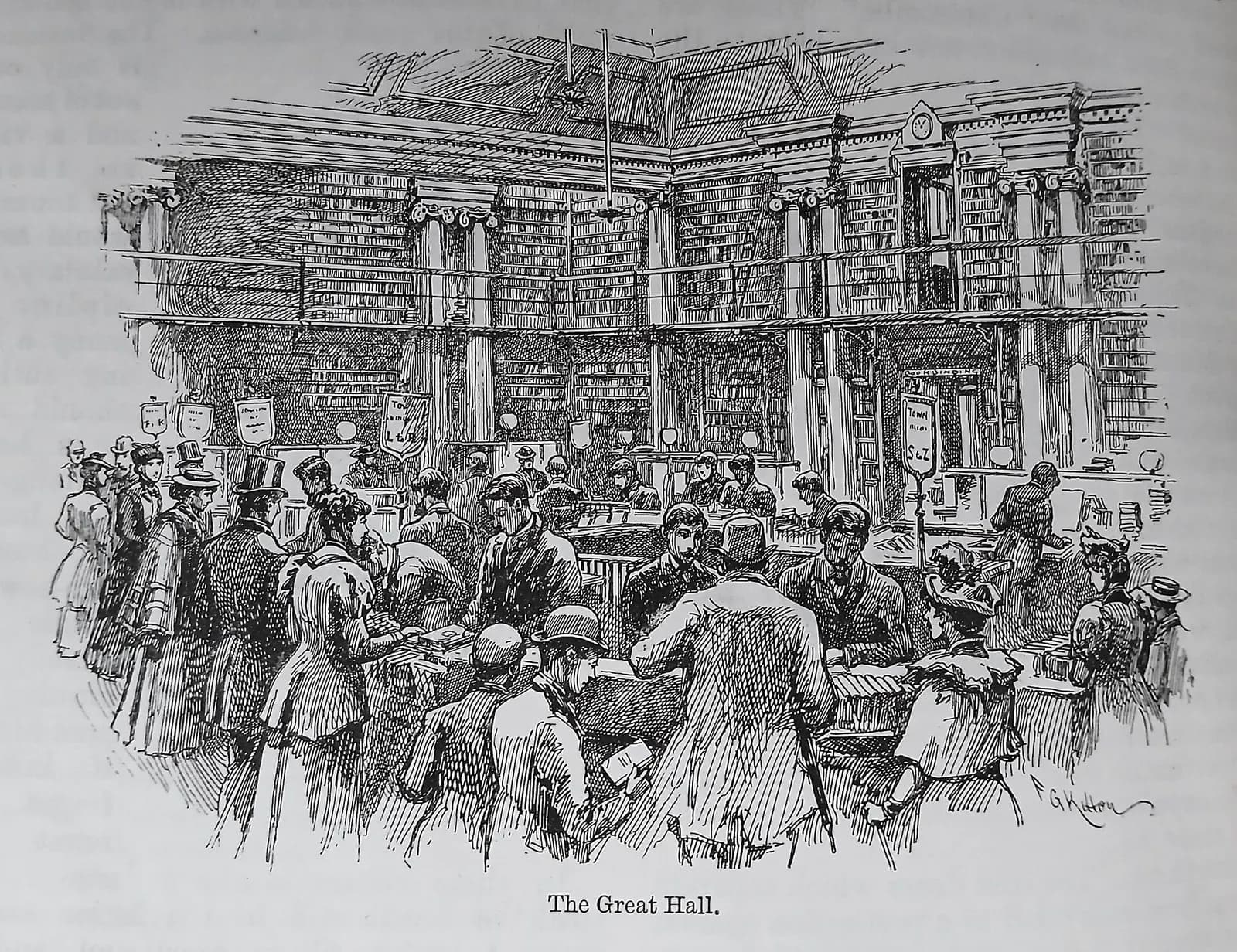

Picture a hall with a domed roof, galleries of books climbing the walls, and clerks packing boxes for the railway. In 1894 the magazine Good Words called it "a spacious and very lofty apartment lighted from a domed roof."1 This was the Great Hall of Mudie's Select Library on New Oxford Street, and by the 1890s it was sending around 1,000 boxes of books out to readers every week.1
It began far more modestly. In 1842 Charles Edward Mudie, who ran a small stationery shop in London, started lending out a few books he happened to love.1 How did a shopkeeper's side project grow into something that helped decide what shape a novel came in? The answer lies in a very ordinary thing: the fine print of a yearly fee.
One guinea, one book at a time
The deal was simple. A guinea bought you a year's membership, and you could borrow one volume at a time. If you wanted more, there were dearer plans for four or eight volumes at once.2 A guinea was 21 shillings, which was real money, but the price was cleverly set. That basic subscription cost about two thirds of the price of a typical three-volume novel, whereas earlier circulating libraries had generally charged about double a novel's price.1
That "typical" novel was the three-decker. From the 1820s to the 1890s, a new novel in three volumes was usually offered to the public at one and a half guineas, or 31s 6d, a price that Walter Scott's Kenilworth had been the first to command.1 Almost nobody paid it. You joined the library instead.
The arithmetic of the three-decker
Here is where the subscription starts steering the product. According to the Victorian Web, Mudie's paid just 15s for a set that listed at 31s 6d.3 Better still, a novel split into three volumes could be lent to three subscribers at the same moment, one volume each.3 The library got more borrowing out of every copy, and the publisher got a big, dependable order.
How big? Figures compiled from publishers' archives suggest that around 1860, sales to Mudie's made up at least a fifth of a novel's print run in three out of four cases, and for some titles the library took half or more of the copies.1 Darwin's On the Origin of Species had a print run of 1,250 copies, and Mudie reserved 500 of them.4 The library was thought to buy about 100,000 volumes a year, and its subscribers were estimated at 50,000, though no ledgers survive to check either number.41
With the libraries buying most of the first edition, the high price had little to do with ordinary readers. One scholar, Roberts, put it bluntly: the price "functioned solely as a deterrent to individual buyers."1 In plain terms, it kept you from buying and nudged you toward borrowing.
One popular idea is wrong, though. Mudie's did not stock only three-deckers. They were never more than 40% of the novels in any catalogue, which grew from 797 titles in 1848-9 to 15,418 by 1907.2 The library had branches in York, Manchester and Birmingham too.5
"The right of selection"
A library that big could also say no. In 1860 Mudie wrote, "I have always reserved the right of selection," and he asked for fiction suited to "young people."6 The Victorian Web goes further and describes the library as a censor demanding fiction fit for the middle-class family.3
Authors felt it. George Meredith wrote that he had offended "Mudie and the British Matron" after the library declined to advertise The Ordeal of Richard Feverel.6 George Moore's first novel, A Modern Lover (1883), was refused by the libraries in any numbers, and his A Mummer's Wife (1885) was banned. Moore then turned to cheap one-volume books with his friend and publisher Henry Vizetelly.7 By Moore's own account, the trouble with the first novel began when "two ladies from the country" complained about a scene.6
Yet the picture is messier than "Mudie dictated the content." The historian Karen Wade concludes that "Selection was applied unevenly at best," and points to research suggesting the library's own finances often counted for more than taste or morals.6 A fair summary is that Mudie's could close a door, but it did not do so often.
Twenty-seventh of June
By the 1890s the three-decker was becoming a burden. On 27 June 1894, Mudie's and W. H. Smith's issued announcements on the same day. From the next year, they would pay no more than four shillings a volume, and they wanted no cheaper edition to appear until a year after the first.8 By then the library was run by Charles's son, Arthur Oliver Mudie, because the founder had died in 1890.5
The trade magazine The Publishers' Circular called it a "crisis" and predicted "a revolution in literature." William Heinemann promptly issued Hall Caine's The Manxman in one volume, with no three-volume edition at all.8 Meanwhile Mudie's head said the three-volume form did not suit the library "at any price" as well as one volume, and the storerooms, nicknamed the "Catacombs," were crowded with copies nobody wanted.8
Was it overnight? Not quite. The scholar Troy Bassett counts 112 three-volume novels published in 1894 and only two in 1897.8 That is a collapse, but it took about three years, and Mudie's 1895 catalogue still listed triple-deckers as almost 30 per cent of the collection.6
What a fee can hide
Mudie's own story ended more quietly. By the 1920s, "better managed rivals" such as W. H. Smith and Boots the Chemist had taken over the market.9 A court order closed the library on 12 July 1937, and The Times described it as the extinction of "a national institution."10 Its business records were lost, so we will never see the ledgers.6
Go back to that busy hall. Nobody there was thinking about the shape of the novel. They were just paying a guinea, taking one book at a time, and waiting. Yet the terms of that membership quietly shaped what got printed and how.
That is still worth remembering when a renewal notice arrives. The headline price is only half the story; the limits, the tiers and the date it renews matter just as much. Subblink keeps every subscription, its price and its renewal date in one place, so a forgotten or unused one is easier to spot. And if you decide a subscription has had its run, Subblink publishes free step-by-step cancellation guides for popular services.
Sources (10)
- Mudie's Select Library and the Shelf Life of the Nineteenth-Century Novel, Introduction (excerpt) — Cambridge University Press (Karen Wade)
- Mudie's Select Library Online: About This Project — University College Dublin (Curatr)
- Mudie's Select Library and the Form of Victorian Fiction — The Victorian Web
- Charles Mudie (Scientist of the Day) — Linda Hall Library
- Charles E. Mudie Papers, Finding Aid (MSS00042) — Rare Book and Manuscript Library, University of Illinois at Urbana-Champaign
- Mudie's Select Library and the Shelf Life of the Nineteenth-Century Novel (Cambridge Element, full text) — Cambridge University Press (Karen Wade, 2025)
- George Moore: Biographical Summary — George Moore Association
- Richard Menke, "The End of the Three-Volume Novel System, 27 June 1894" — BRANCH: Britain, Representation and Nineteenth-Century History
- Booksellers and rental libraries — Moonstone Press
- Place through time (where New Oxford Street meets Museum Street) — Adam Smyth (Substack)
Try Subblink free.
Add your subscriptions and see what you spend each month. On a paid plan, Subblink can scan your Gmail and find them for you. Email scanning works with Gmail only for now.
Start freeFree for unlimited subscriptions. No credit card.