The Christmas Account That Paid You Nothing, and the Year It Broke
5 min read
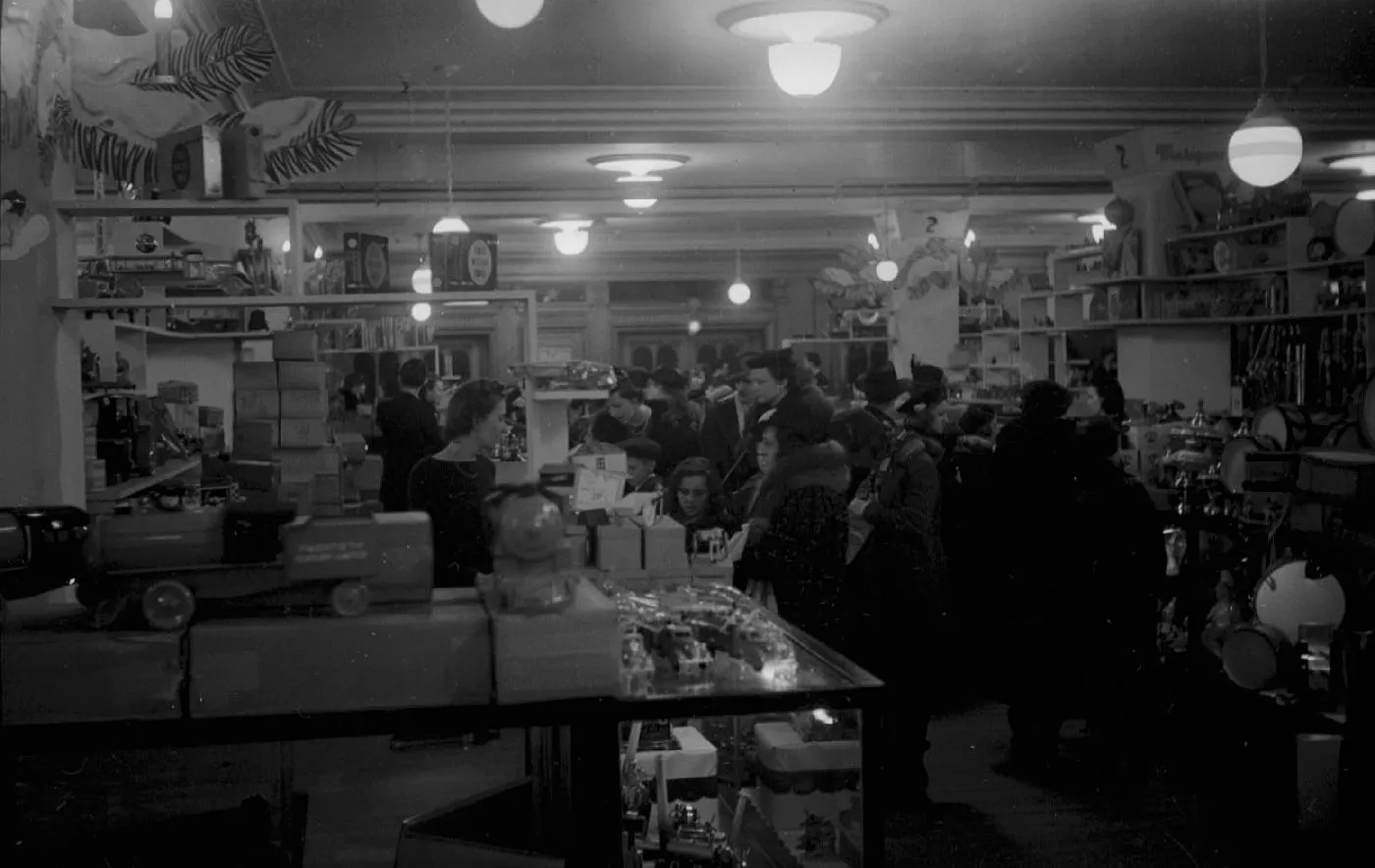

Picture a bank treasurer in a small Pennsylvania town, a little over a century ago, pitching what sounds like a bad deal. Come in every week, hand us a little money, and you can't have it back until just before Christmas. We won't pay you much for the trouble, and for a long time we won't pay you anything.
People signed up anyway, and they kept signing up for decades. Why would anyone choose an account that pays nothing? And what happens when that same urge to save for December runs into a company that isn't a bank?
A treasurer in Carlisle
The treasurer was Merkel Landis. He joined the Merchants Bank in Carlisle, Pennsylvania, in 1901, and the bank was later renamed the Carlisle Trust Company, where he became treasurer and eventually president.1 Who gets the credit, and when, is a little fuzzy. American Banker says the Christmas club is believed to have started in 1909, when about 350 people each saved roughly $28, a figure it attributes to another publication.2 Dickinson College's archive says Landis developed the first version of his "Christmas Savings Fund" in 1910.1 Call it the turn of the decade.
The idea was simple. You put away a set amount on a regular schedule, usually weekly or biweekly, and the bank handed the savings back around early November so you could shop without going into debt.2 Critics later pointed to the high fees and low interest rates that came with the clubs. Still, they thrived: American Banker says they peaked from the Great Depression to just after World War II.2
The planner and the doer
Economists found all this baffling. In a working paper from the late 1970s, Shefrin and Thaler wrote that "Christmas clubs have always been a real puzzle for economists."3 For many years the clubs paid no interest, and an ordinary savings account looked better on paper.3
Their answer was self-control. They described a person as behaving as if they had two sets of preferences, which they called the planner and the doer.3 The planner, in January, wants the presents paid for. The doer, in March, would like to spend it on something nice right now. A Christmas club is the planner's trick for tying the doer's hands. The authors put it in the same family as mandatory pension plans, payroll savings plans, whole life insurance and even piggy banks, all of which reduce your flexibility on purpose.3
The trick never really went away. In December 2007, American Banker reported that three out of four credit unions offered holiday savings accounts.2
The vouchers that never came
Britain had its own version. Farepak sold hampers and, more significantly, vouchers that could be cashed in at various retail stores.4 Customers paid money over the year, and in the autumn they were issued vouchers to spend in the run-up to Christmas. Between January and October 2006, those deposits came to more than £35 million, maybe as much as £41 million, according to the judge in a later court case.4
Then, on 13 October 2006, Farepak and its parent company, European Home Retail, collapsed.5 Farepak owed customers and agents about £37 million that it couldn't pay.4 More than 100,000 people lost their deposits, and one count put the creditors at 114,000, customers and agents together.46
Why was there nothing to pay them with? The judge explained that the deposits were treated as general trading money, swept daily into group accounts at the group's bank and from there into the parent company.4 Farepak's main asset was a £33 million debt owed by that parent, which couldn't pay it either. A rival, Park Group, did it differently and basically ringfenced its customers' deposits.4 In plain terms, the savers' money had never been sitting in a locked box.
What was left, and what changed
Help arrived in pieces. A charity, the Farepak Response Fund, paid customers 17.5p in the pound in 2006. In 2012 the liquidator said it would pay about 32p more, helped by an £8 million payment from Lloyds Banking Group, which by then owned HBOS. Together that came to roughly 50p in the pound.6
The courts took a different path. Proceedings to disqualify nine former directors began in 2011, but the Secretary of State discontinued them on 20 June 2012, less than a month after the High Court hearing began.5 Mr Justice Peter Smith called that decision "both correct and inevitable." He also said the directors "made genuine strenuous efforts to save the group and the depositors," and that HBOS "had a policy of playing hardball."4 Business Secretary Vince Cable called the result "disappointing."5
The industry changed its rules slowly. In July 2012 the Christmas Prepayment Association began requiring members to put customers' payments with an institution covered by the Financial Services Compensation Scheme.7 MoneySavingExpert's Dan Plant called it a "huge missed opportunity," because that protection only applies if the bank fails, not the savings club.7 The law caught up much later: since 1 January 2026, UK Christmas savings clubs have had to protect customers' prepayments with either insurance or a trust run by independent trustees.8
Christmas, in reverse
Now flip the whole thing around. Instead of paying before Christmas for a gift you don't have yet, you take it home today and pay in instalments afterwards. That is buy now, pay later, and in the UK it has been regulated by the Financial Conduct Authority since 15 July 2026.9 Lenders must check you can afford the repayments, show the amounts, dates and late fees up front, and get in touch if you miss a payment. There are gaps, though: credit offered by the same business that sells the item isn't covered, and neither are agreements made before that date.9
In the US, the picture is different. On 12 May 2025 the Consumer Financial Protection Bureau withdrew several guidance documents, including its 2024 interpretive rule on buy now, pay later.10 All of this is current as of 1 November 2026, and rules like these do change.
Back in Carlisle, the treasurer's pitch looks less strange now. Paying ahead and paying afterwards are two sides of the same bargain: small, scheduled payments that feel painless until nobody is watching the dates. Farepak's lesson is that it matters where the money sits and when it's due. The same goes for the monthly charges you've half forgotten. That is why Subblink keeps every subscription, its price and its renewal date in one place, so the planner in you can see what the doer signed up for.
Sources (10)
- Merkel Landis (1875-1960) — Dickinson College Archives & Special Collections
- Christmas Clubs — American Banker (originally Credit Union Journal)
- An Economic Theory of Self-Control (NBER Working Paper No. 208, revised July 1978) — National Bureau of Economic Research
- Statement by the Judge, Mr Justice Peter Smith, 21 June 2012 (Farepak disqualification proceedings) — Courts and Tribunals Judiciary (judiciary.uk)
- Business Secretary Vince Cable statement on Farepak — GOV.UK (Department for Business, Innovation and Skills)
- Farepak customers to get half of money owed back — MoneySavingExpert
- Christmas club savers' cash to be better protected — MoneySavingExpert
- Consumer savings schemes: legislation for businesses — GOV.UK
- Buy Now Pay Later — Financial Conduct Authority
- Buy Now, Pay Later (BNPL) products — Consumer Financial Protection Bureau
Try Subblink free.
Add your subscriptions and see what you spend each month. On a paid plan, Subblink can scan your Gmail and find them for you. Email scanning works with Gmail only for now.
Start freeFree for unlimited subscriptions. No credit card.