Audubon Sold The Birds of America Five Plates at a Time, and Subscribers Quit
5 min read
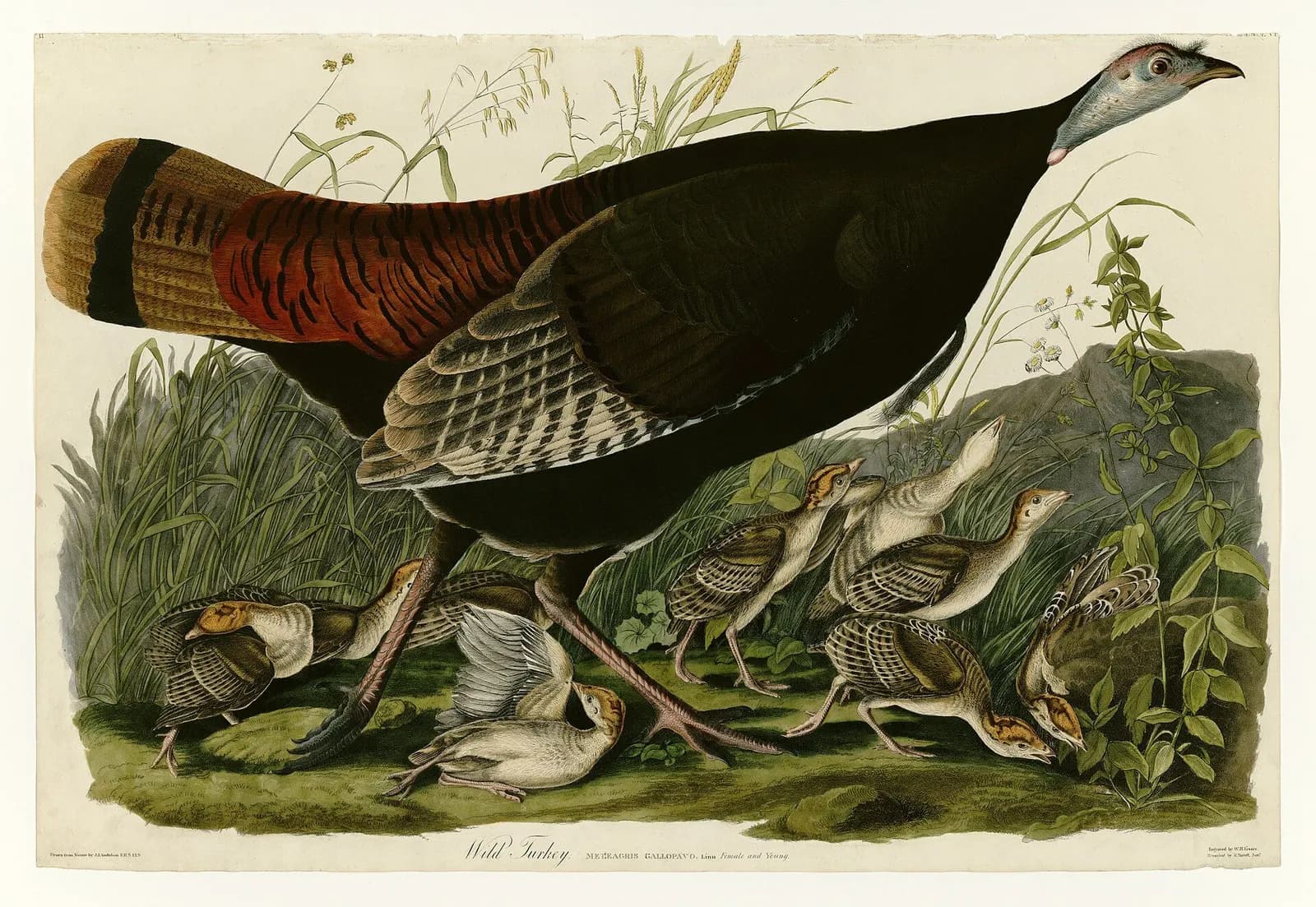

On 12 May 1830, John James Audubon sat down to write to a botanist friend in England and admitted something awkward. "I have only 5 Subscribers in the whole of the U. States," he wrote. A few lines later he added, "The work is admired but the Price is yet much too great."1
Hold that picture for a moment. Today his Birds of America is spoken of in the same breath as the great treasures of the printed word. But three years into publishing it, Audubon was mostly an anxious salesman with a list, hoping the next person on it would say yes. How did a book that grand get made on a promise and a trickle of payments?
A parcel of five
Nobody bought The Birds of America as a book. They signed up for "Numbers." Each Number was a parcel of five hand-coloured prints, one large bird, one medium bird and three small ones.23 Audubon told his wife Lucy in December 1826 that "the price of each number is Two Guineas," and the money was due when the parcel was delivered, not before.4
That meant the buyer paid as they went, like a magazine that arrives in loose sheets you bind yourself. The finished work ran to 87 Numbers and 435 plates, which subscribers had bound into volumes, 100 plates in each of the first three and 135 in the fourth.2 Audubon had first planned 80 Numbers, and the work grew as he kept going.4 In all, a complete set cost a subscriber about $1,000.23
Why sell it this way? Because every plate had to be engraved and coloured by hand, and nobody was going to hand Audubon that much money in one go. Subscriptions let him collect as he went, and he was not alone in the trick. A Lehigh University exhibit notes that Audubon, Alexander Wilson and John Gould all used subscriptions to cover costs in advance.2
The man in the bearskin cloak
The catch is that a subscription only works while people keep subscribing. Audubon began planning a prospectus in 1826, a printed pitch to win buyers for each new batch of plates. It went through six printings, and Waldemar Fries knew of only 16 surviving copies when he wrote his 1973 study of the book.5 Then trouble came from the workshop. His first engraver, William Home Lizars of Edinburgh, lost his colourists to a strike during the second batch of plates, and Audubon moved the job to Robert Havell Jr. in London.4
Havell would spend roughly eleven years engraving, printing and colouring the plates, and he drew many of the backgrounds himself.4 Think of the wild turkey hen with her chicks on plate 6, one of the earliest Numbers to reach subscribers. Behind every bird like that was a workshop that needed paying long before the next round of money arrived.
So Audubon went out to find it. He visited Havell's shop to watch over production, and he crossed the Atlantic several times to look for more subscribers.23 In the salons of London and Paris he played the eccentric American woodsman, bearskin cloak and all.3 He hung 250 of his paintings at the Royal Institution in Liverpool, then showed more in Manchester and Edinburgh, while his son Victor handled business in London.4 By the end of 1827 he had about 100 subscribers.4
They were not only wealthy private buyers. The York Subscription Library signed up early, and in Philadelphia so did the Academy of Natural Sciences and the American Philosophical Society.4 Among the notable names were European aristocrats and, in America, Senator Daniel Webster.3
The ones who left
Here is the part that should feel familiar. Paying Number by Number meant every delivery was a fresh chance to quit, and over eleven years plenty of people took it.
The counts differ depending on who you ask, so treat them as a rough picture. Lehigh says Audubon first won 279 commitments, ended with 161 names on the final list (82 American and 79 European), and saw 56 of the original subscribers cancel before the full set was out.2 Sotheby's calls the 161 only a "notional" measure, since some listed names never finished their sets and some collectors bought complete sets without appearing on the list at all.4 Yale adds the plainest reason of all: some subscribers died, and some cancelled, which left some sets incomplete.3
Even so, enough people stayed. Christie's says about 200 first-edition copies were completed, and 161 of them were made for paying subscribers.6 When printing ended in 1838, fifteen complete sets that no subscriber had bought were still waiting.4 The risk had sat with Audubon the whole way, and he carried it to the finish.
What the survivors are worth now
For the sets that made it through, the value came slowly. New York City bought its set in 1850 for about $1,000. In October 1985, at Sotheby's, a binder separated its four volumes so the 435 prints could be sold one by one, raising $1.441 million.7 Yale notes that many sets met a similar fate and were broken up into individual plates.3 That is part of why complete ones are scarce. Christie's put the known complete sets at about 120 in 2018, 107 in institutions and 13 in private hands.6
On 7 December 2010, a complete set from the Lord Hesketh collection sold at Sotheby's in London for about $11.5 million (£7.3 million), a record for a printed book at auction. The buyer, dealer Michael Tollemache, called it "priceless."8 In June 2018 Christie's in New York sold the Duke of Portland copy for $9,650,000, the second-highest price at auction for a full folio set.9
Audubon used the same method again later. His royal octavo edition, a smaller version with 500 plates in seven volumes, was also sold by subscription, at $100 a set, with a subscribers list printed in every volume.10
Eleven years is a long time
Go back to that 1830 letter. Audubon's trouble was never that people didn't want the birds. It was that small payments stretched over a long time are easy for a buyer to stop, while the maker has to fund everything up front. Every few months, a subscriber had to decide again.
Most of us make the same small decision all the time, only with more parcels and far smaller amounts. A streaming service here, a cloud plan there, each one easy to forget by the second year. That is the gap a tracker like Subblink fills: it keeps your subscriptions, their prices and their renewal dates in one place, so continuing is something you choose rather than something that happens to you.
Sources (10)
- From J. J. Audubon, 12 May 1830 (letter to J. S. Henslow) — Epsilon, Henslow correspondence
- Subscriptions (Lehigh University exhibit on Audubon's Birds of America) — Lehigh University Libraries
- Audubon's Birds of America at Yale: creating a masterwork one feather at a time — Yale News
- Audubon, The Birds of America, Indiana Historical Society copy, Lot 101 (catalogue essay) — Sotheby's
- Rauner celebrates the work of John James Audubon — Dartmouth
- Christie's brings the Duke of Portland copy of Audubon's Birds of America to auction (press release, 25 April 2018) — Christie's (via Art & Object)
- The sale of a first edition of John James Audubon's The Birds of America — NYC Department of Records & Information Services
- Rare 'Birds of America' book sells for $11.5M, breaks record — NBC News
- Auctions, June 15, 2018 (Birds of America sells for $9.65 million at Christie's) — Fine Books & Collections
- Audubon, The Birds of America (royal octavo edition), Christie's lot 233 — Christie's
Try Subblink free.
Add your subscriptions and see what you spend each month. On a paid plan, Subblink can scan your Gmail and find them for you. Email scanning works with Gmail only for now.
Start freeFree for unlimited subscriptions. No credit card.